Two weeks ago, from 28 to 30 March, the Drupalcamp Roazhon 2024 in Rennes took place.
The event was sold out with 250 participants, which is a very good result and a positive sign for the resumption, I hope regular, of Drupalcamp. The last French Drupalcamp having been Paris 2019 and in the meantime a certain global pandemic has disrupted the regularity of the camps.
Smile was present with around ten participants and as a 'full galette' sponsor (the highest level of sponsorship in case the originality of the names of this edition's sponsorship packages isn't clear :) ).
Here's a summary of the sessions I attended or co-presented, as well as the contributions made.
Let's go crazy! What if Drupal did less in the runtime?
I missed the first 10 minutes of the presentation as I was busy on contribution topics.
Very technical and low level presentation on the container. Very interesting as usual.
To sum up, by making the service container less dynamic and pre-calculated significant gains in performance, predictability and better static analysis via PHPStan would be possible.
Round table: What's a site factory?
First time I've taken part in a round table at an event. It went very well.
Thanks to Jean Fenouil for unexpectedly joining the participants in order to balance the number of "technical" and "non-technical" participants.
It was a time for sharing points of view and not for debate because we were all pretty much in agreement that there is no single typology of site factory, but that a site factory is specific to each project.
The client/provider organisation and the choice of technical solutions depend on the following points (non-exhaustive list):
- How many sites will be produced?
- Will content be shared between sites?
- What is the RACI?
- Is the provider responsible for managing the sites thus produced? In part? In full?
- Will there be other service providers involved?
- Will the site factory be brought in-house by the customer teams after the construction phase? Will there be dedicated teams trained in Drupal?
- What will be the differences between the sites? Functionalities, graphic charter, administration team, content?
- How to deploy a new site?
Given the multitude of cases, it is therefore impossible to satisfy them all with a single solution and in the end we have addressed more the questions to be asked in a "site factory" type project.
Hence also the difficulty of answering certain questions because a site factory very quickly becomes specific.
As for the technical aspects, regarding the content sharing issue I'll say that the Entity Share module helped solve a lot of situations given the positive feedback I got from it, and the mention of the module in slides and conversations throughout the camp!
I think that the technical aspect that remains the thorniest now remains configuration management, as soon as it comes to dealing with configuration updates and possible customisations from one site to another.
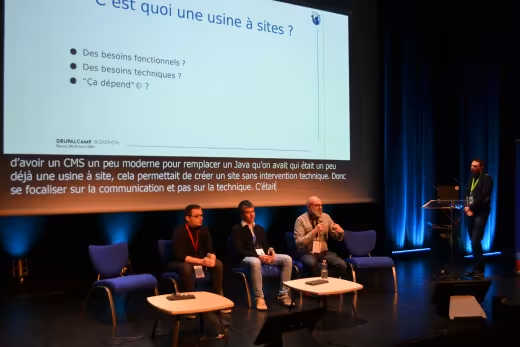
The round table participants, before being joined by Jean.
The two Render APIs, how to appreciate the good and avoid the bad
A fairly technical talk explaining the rendering mechanisms in Drupal or how the Renderer service and Theme Manager are linked.
With an opening on the new component rendering system now integrated into Drupal core. A simplification of the rendering mechanisms would enable performance gains and, above all, faster learning of the Drupal render API.
Towards a new render API in Drupal?
With FrankenPHP, PHP returns from the dead
Time to see what's being done elsewhere outside Drupal.
FrankenPHP or how to make PHP benefit from Go's advances at the runtime level by transforming the entire application (Drupal + PHP + web server) into an executable binary for performance gains and ease of deployment.
However, this also brings with it a set of constraints and at the moment Drupal isn't ready to satisfy these constraints.
So several contributors contributed after the session to test Drupal with FrankenPHP to see what there is to improve. More info in the following issues:
- https://www.drupal.org/project/drupal/issues/3437187
- https://www.drupal.org/project/drupal/issues/2218651
Code review for everyone
I was able to co-present with Lydie Fromont the subject of code review in order to raise awareness of its interests, the benefits obtained in terms of code quality and team knowledge.
More details in the presentation materials :
Code reviews for everyone 1.55 MB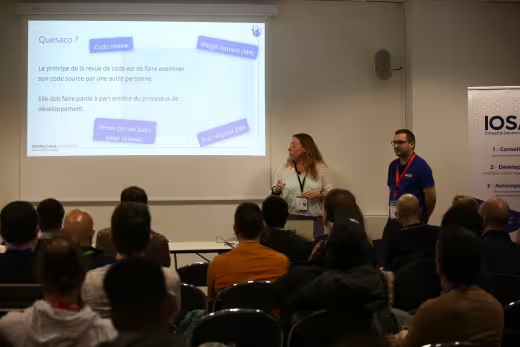
© Vincent Maucorps licensed under Creative Commons BY-NC 4.0.
Crop & Media: the next step
The presentation starts from the observation that the crop ecosystem in Drupal is primarily designed to act at the level of an image managed directly by a media field. In other words, not natively reusable.
Except that since Drupal 8.4 (October 2017), the media functionality is directly in the kernel, with therefore the possibility of reusing images already present.
This therefore raises the problem of how to enable a crop depending on the use of the image and no longer depending on the image to have different crops depending on the use because multiplying the number of image styles will not be the solution.
So it's the purpose of the Media Contextual Crop API ecosystem to try to solve this problem.
In my career, I haven't so far been on projects requiring such a degree of finesse in media and crop management, and so haven't yet encountered this problem. But if it does arise having a suite of modules to address it will be very handy.
Association Drupal France et francophonie, questions & réponses
As the association has made its AGO on the Tuesday just before the camp, a session presenting the association, the new board and the projects in progress came just at the right time to reinvigorate the latter.
As far as events are concerned, I think it's great that we want to alternate years with a camp and years with splash awards that are more business-oriented and showcase Drupal achievements. So that each profile has an interest in the events while avoiding/reducing pressure on camp organisers an annual frequency.
Contribution
In the week before the camp, I made the Psalm plugin for Drupal compatible with Psalm 5, this made it possible to do without dependencies marked as more maintained.
During the camp, I uploaded Sobki, the new Smile installation profile, available at the following URLs:
- Sobki : the entry point providing documentation common to the different variations of Sobki.
- Sobki Admin Theme : the administration theme common to the different variations.
- Sobki Bootstrap : Sobki based on the Bootstrap 5 design system.
- Sobki DSFR : Sobki based on the French state design system. In the very early stages of development at the time of the camp.
During the week, before and during the camp, I contributed to the UI Suite ecosystem on the following issues:
- https://www.drupal.org/project/ui_suite_bootstrap/issues/3426475
- https://www.drupal.org/project/ui_suite_bootstrap/issues/3423235
- https://www.drupal.org/project/ui_suite_bootstrap/issues/3427151
- https://www.drupal.org/project/ui_suite_bootstrap/issues/3437118
- https://www.drupal.org/project/ui_suite_bootstrap/issues/3426391
- https://www.drupal.org/project/ui_patterns_settings/issues/3437139
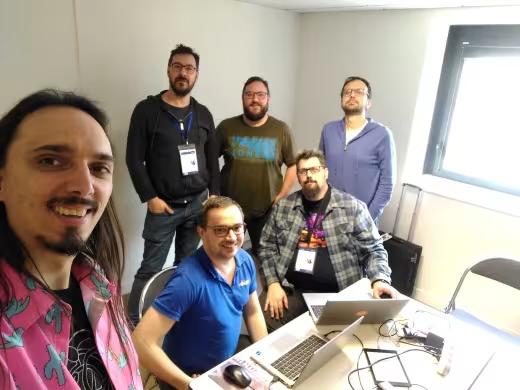
I was also able to do a bit of mentoring and take part in discussions about:
- Entity Share
- UI Icons: the kickoff to this new UI Suite topic.
- the revival of the Statistics module: now that the module is out of the kernel, I've taken a look back at statistics needs already encountered on projects.
Conclusion
The DrupalCon in Lille 5 months earlier had already allowed me to see a lot of people from the French-speaking Drupal community again, but it wasn't like having a dedicated camp on a smaller scale, which is fine. It gives a really good sense of community and at this scale alone, you barely have time to bump into some of the attendees.
I'd like to thank Vincent for mentioning me when he was promoting Sobki on stage. A great spotlight on UI Suite this year!
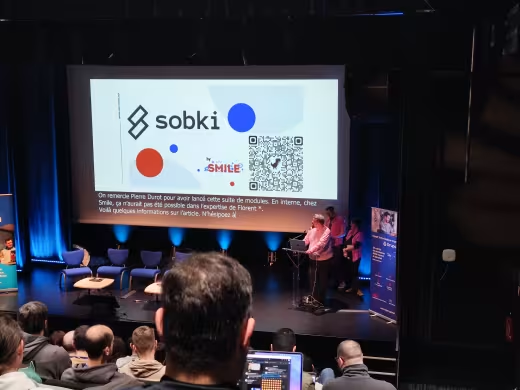
Message from sponsor Smile, announcement from Sobki by Vincent Maucorps.
Thanks to the organisers, volunteers (clearly visible with the pink shirts :)), sponsors, participants and Smile for sending me there.
Videos: https://www.youtube.com/playlist?list=PLfn228hCw1tGd0GdbIcz0hSjWrfZnd56q
Photos: https://www.flickr.com/photos/196542885@N02/albums/72177720315791559/